Fomo Risk Management Review: Spot-Only, No Margin Call
Lotsight ranks brokers on how they handle the fact that leveraged CFDs can cost you more than you deposit. Fomo sits at the other end of that spectrum: spot-only, no margin call, no negative balance, and a risk library that prints the recovery maths instead of hiding it.
7.5/10 overall score
Best for: Traders who want memecoin and new-token exposure with a hard ceiling on the loss, and who will actually read a sizing rule before they size a position.
Judged on the one axis this site cares about — what happens when the trade goes against you — Fomo scores better than its name suggests. Spot-only exposure means the worst case is the amount you put in, with no margin call and no negative balance to settle. The published risk material is specific where most broker pages are vague, and the app lists FOMO buying as a mistake in its own guidance. What it is not is a regulated venue: there is no licence to verify, no investor compensation scheme, and the trading fee percentage is still unpublished, so the true cost of following the sizing rules cannot be modelled from the outside. Size it as speculative money you can write off, and the structure will do the rest of the work.
How this review was done. Lotsight reviews normally come from an account we funded, traded and withdrew from. This one does not. Fomo is a self-custody crypto app rather than a regulated broker, so there is no licence to look up and no statement to download. What follows is a desk review of the material FOMO Labs Inc. publishes about its own product, with every claim attributed to the page it came from. The subject is narrow and deliberate: Fomo risk management, and whether the guidance the company publishes would survive contact with a real position.
The reason to run it here is the banner at the top of this site. Lotsight exists because leveraged CFDs let retail traders lose more than they deposit, and most of the ranking is about how brokers handle that. Fomo sits at the opposite end of that spectrum, and the Fomo risk management material is unusually blunt for a product whose whole name is an emotion.
The fomo homepage. Source: fomo.family
Spot only: the ceiling on what you can lose
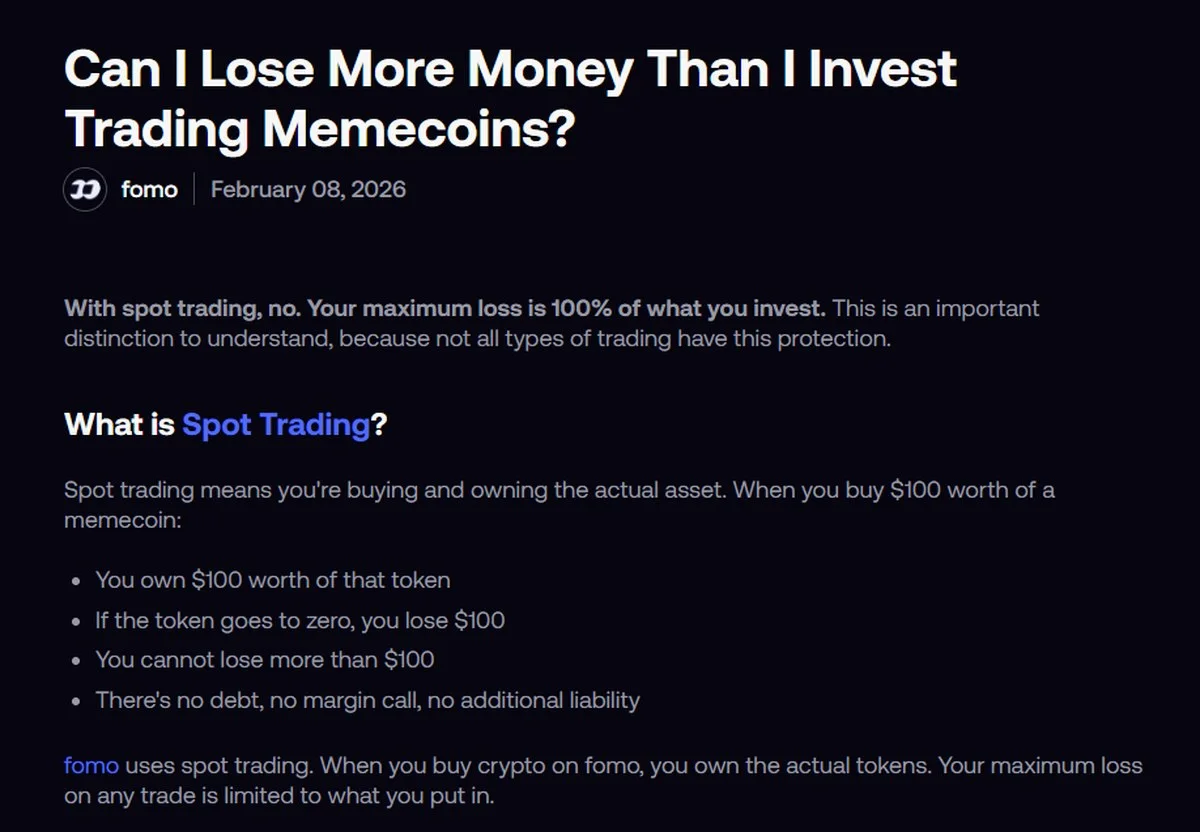
Start with the structural point, because for a Lotsight reader it is the most important one. Fomo is spot. You buy the token and you own it. The company states it plainly: “With spot trading, no. Your maximum loss is 100% of what you invest”, and the consequences it lists are “no debt, no margin call, no additional liability”.
fomo sets out the difference between spot and leveraged exposure. Source: fomo.family/answers
It then spells out the contrast most brokers would rather you did not dwell on: with leverage, “a 10% drop with 10x leverage means 100% loss”, plus liquidation risk. That is the mechanism behind the warning at the top of this page.
Understand what this does and does not buy you. It caps the size of the worst case at your stake. It does nothing about the probability of reaching it, and on memecoins that probability is high. A 100% loss with no margin call is still a 100% loss.
The sentence a marketing team would normally cut
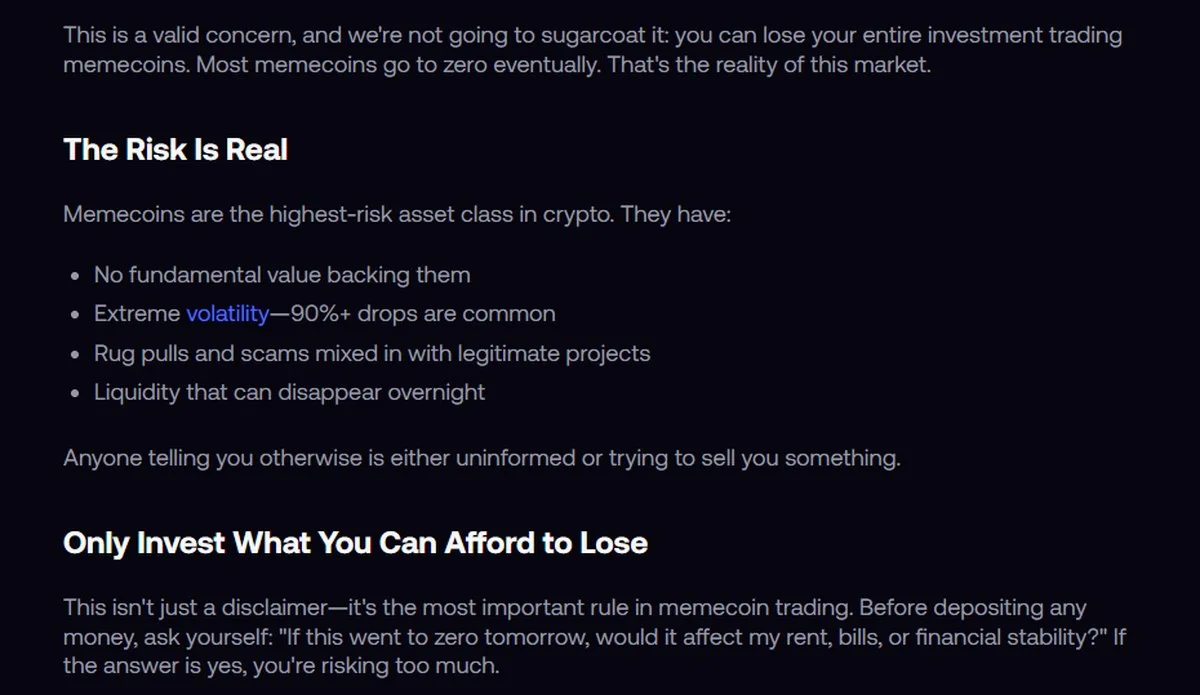
On the page titled “What if I lose everything”, the answer opens: “This is a valid concern, and we’re not going to sugarcoat it: you can lose your entire investment trading memecoins. Most memecoins go to zero eventually. That’s the reality of this market.”
The risk section on fomo.family, in the company own words. Source: fomo.family/answers
It lists four properties of the asset class — no fundamental value, “90%+ drops are common”, rug pulls mixed in with legitimate projects, and liquidity that can disappear overnight — and closes the section with: “Anyone telling you otherwise is either uninformed or trying to sell you something.”
Then the test it suggests before you deposit: “If this went to zero tomorrow, would it affect my rent, bills, or financial stability?” If yes, “you’re risking too much”. That page sits inside a whole library of plain-language risk answers on the Fomo site, and we have read a lot of broker risk pages for this site. Very few put it that directly.
Fomo risk management in practice: position sizing with real numbers
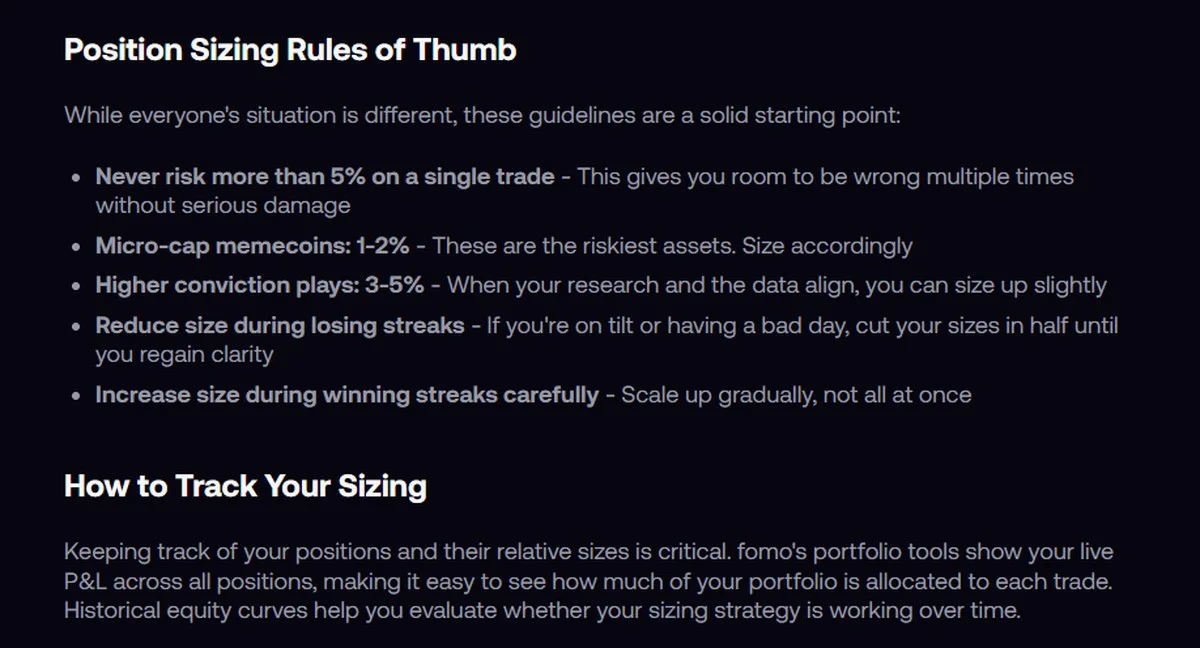
The sizing guidance is the part a forex trader will find most familiar, and it is specific rather than hand-waving:
Never risk more than 5% on a single trade — “This gives you room to be wrong multiple times without serious damage”.
Micro-cap memecoins: 1-2% — “These are the riskiest assets. Size accordingly”.
Higher conviction plays: 3-5% — only when research and data align.
Reduce size during losing streaks — “If you’re on tilt or having a bad day, cut your sizes in half until you regain clarity”.
Increase size during winning streaks carefully — “Scale up gradually, not all at once”.
The sizing rules fomo publishes. Source: fomo.family/answers
The reasoning underneath it is the recovery maths every trader eventually learns the hard way: “Losing 50% of your portfolio requires a 100% gain to break even. Losing 10% only requires 11%.” That is the argument for small size, stated in one line, and it is the core of Fomo risk management as the company teaches it.
An app called Fomo listing FOMO buying as a mistake
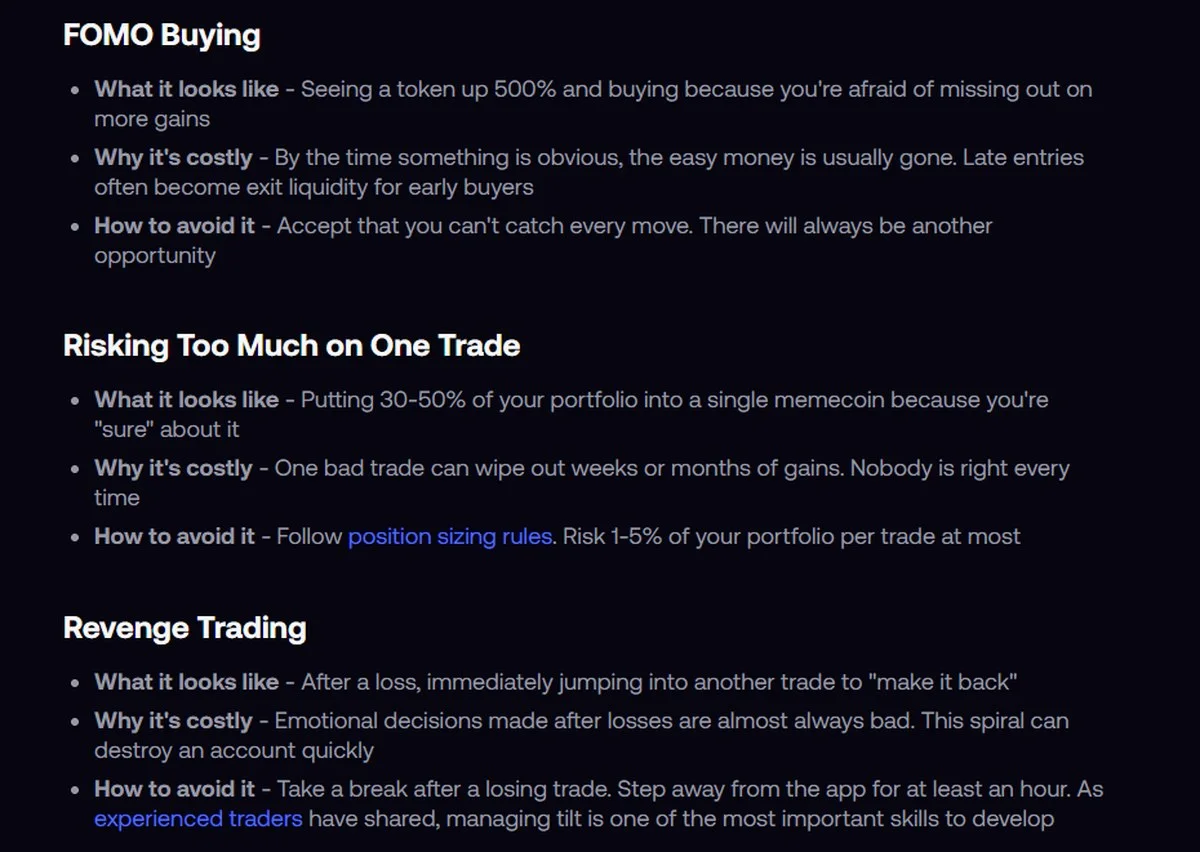
This is the part that made the review worth writing. The company’s guide to the biggest mistakes new traders make includes, by name, FOMO Buying: “Seeing a token up 500% and buying because you’re afraid of missing out on more gains.” Why it is costly: “Late entries often become exit liquidity for early buyers.”
The mistakes list, including the one the app is named after. Source: fomo.family/answers
The same page covers overtrading (“Set a daily trade limit”), having no exit plan (“Decide on your exit strategy before you buy”), risking 30-50% of a portfolio on one token, and revenge trading. The advice on that last one is the most striking thing on the site: “Take a break after a losing trade. Step away from the app for at least an hour.”
An app monetised by trading volume telling users to close it for an hour is either unusual integrity or unusual confidence. Either way it is on the record, and you can read the guidance on fomo.family yourself.
Risk-to-reward, and why a 30% win rate can work
The R:R page runs the arithmetic rather than asserting it. At 1:3, “Win 3 out of 10 trades at 1:3 and you profit. Lose $100 on 7 trades ($700 loss), gain $300 on 3 trades ($900 gain)”. The four steps it gives are the standard ones: identify entry, set a stop, set a target, divide reward by risk.
Worth naming the gap here, because it matters more on memecoins than on majors. A stop loss on an illiquid token is not the same instrument as a stop on EUR/USD. If liquidity thins, the price you exit at can be a long way from the price you planned to exit at. The R:R framework is sound; the slippage assumption underneath it is doing more work in this asset class.
The tools behind Fomo risk management
Guidance is only useful if the product lets you follow it. Fomo states that its portfolio tools “show your live P&L across all positions, making it easy to see how much of your portfolio is allocated to each trade”, with “historical equity curves” to judge whether a sizing strategy is working over time.
Allocation per position and an equity curve are exactly the two views the 5% rule needs. On the funding side the presets are $25, $50, $100 and $250, which are small enough that a 1-2% micro-cap allocation is a real option rather than a rounding error, and the first buy carries no fee. You can see the current tools and funding options before committing anything.
Where the honesty stops
Two gaps, stated plainly, because a review that only quotes the good pages is not a review.
The fee is not published. Fomo describes pricing as “a straightforward percentage on trades” with “gas included” and “no hidden spreads”, but the percentage itself appears nowhere public. The only hard number is $0 on the first buy. Cost cannot be compared before you install.
The social layer pulls the other way. A leaderboard shows the people who won. It does not show the people who took the same trade and lost, and it does not tell you the size or entry behind a number. Every discipline lesson on the answers pages is fighting the product surface on the home screen.
Neither is disqualifying, and neither undercuts the Fomo risk management material itself. Both are things to know before the first deposit rather than after.
Risk warning
Fomo is not a licensed broker or a regulated exchange. There is no FCA, ASIC or CySEC registration to check, no segregated client money, no deposit insurance and no compensation scheme. If something goes wrong there is no regulator to escalate to.
Memecoins and newly launched tokens are the most speculative assets in retail finance and can go to zero — the company says so itself. Self-custody means the wallet is yours and so is every consequence of losing access to it. Spot exposure caps your loss at your stake; it does not make the loss unlikely. Treat anything you put in as money you can write off in full.
The short version
Judged on the axis this site cares about, Fomo does better than its name suggests. Spot-only exposure means no margin call and no negative balance. The Fomo risk management library is specific where it could have been vague — 5% maximum per trade, 1-2% on micro-caps, halve your size on tilt — and it prints the recovery maths rather than gesturing at it. It names FOMO buying and revenge trading as mistakes and tells users to close the app after a loss.
What it is not is a regulated venue, and the missing fee percentage means the cost comparison this site normally runs cannot be run from outside. If you are coming from leveraged FX and curious about the asset class, read the answers library before you fund anything, size the first position as if it will go to zero, and judge the app on whether its surface lets you keep the discipline its own pages describe.
What we liked
Spot-only structure: the maximum loss is 100% of the position, with no margin call and, in the company’s words, no debt and no additional liability
Position sizing published as numbers rather than platitudes — 5% maximum per trade, 1-2% on micro-caps, 3-5% on high conviction, half size after a losing streak
The risk library prints the recovery arithmetic: losing 50% needs a 100% gain to break even, losing 10% needs 11%
The app names FOMO buying, revenge trading and overtrading as mistakes and tells users to step away for at least an hour after a loss
Portfolio view shows allocation per position plus a historical equity curve, which is what you need to audit your own sizing
What held it back
Not a licensed broker or regulated exchange — there is no FCA, ASIC or CySEC number to verify and no investor compensation scheme behind the balance
The trading fee is described as a straightforward fee per trade, but the percentage is not published, so the cost of following the sizing rules cannot be modelled from outside
Spot only by design, which caps the loss but also means there is no hedging and no shorting
Self-custody puts key storage and recovery on the user rather than on a broker back office
Key facts
Product type
Self-custody crypto trading app (spot only)
Operator
FOMO Labs Inc.
Leverage
None — spot only, no margin, no negative balance
Maximum loss
100% of the amount invested in a position
Regulation
Not a licensed broker or regulated exchange; no FCA, ASIC or CySEC number
Custody
Self-custody wallet, keys held by the user
Trading fee
Described as a straightforward fee per trade; percentage not published
Risk tools
Sizing guidance, live P&L, historical equity curve, allocation per position
Tested by The Lotsight Test Desk with a funded live account. Scores reflect what we saw during testing and are not personal financial advice. CFDs are complex instruments and carry a high risk of losing money rapidly due to leverage.